
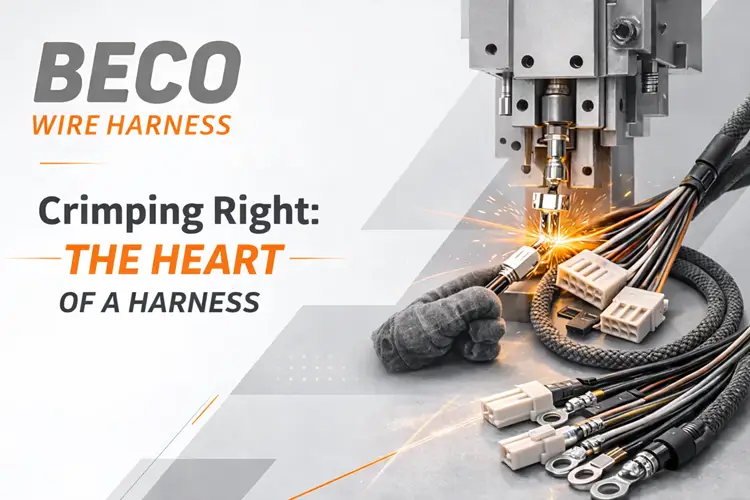
When wire harness reliability is discussed, attention typically goes to connectors, insulation classes, routing strategies, or end-of-line testing. Rarely does the focus shift to the crimp. Yet the crimp is where the true electrical and mechanical interface is formed. It is the functional core of the harness.
A wire harness is only as reliable as its weakest crimp. You can engineer optimized routing, specify premium connectors, and implement rigorous validation protocols. But if the crimp integrity is compromised, the entire system becomes vulnerable.
This is why crimping deserves disciplined engineering attention—not as a routine production step, but as a critical reliability control point.
Why Crimping Is Mission-Critical
A crimp is the controlled compression of a terminal barrel around a stripped conductor. That compression must achieve two outcomes simultaneously:
- Electrical continuity
- Mechanical retention strength
When executed correctly, the copper strands plastically deform and consolidate into a dense, homogeneous mass. Air gaps are minimized. Contact resistance decreases. The interface becomes gas-tight, limiting oxidation and long-term corrosion.
When executed poorly, the consequences escalate quickly.
A loose crimp increases electrical resistance. Elevated resistance generates heat. Heat accelerates insulation degradation, voltage drop, signal instability, and eventual circuit failure. In automotive, industrial automation, or heavy machinery applications, this can result in unplanned downtime or safety exposure.
Crimping is not simply an assembly step. It is a reliability decision.
Crimp Types and Application-Specific Techniques
Crimp selection depends on current rating, mechanical load, environmental exposure, and terminal architecture. Different applications require different geometries and tooling strategies.
Open Barrel Crimp
Common in automotive and appliance harnesses. The terminal features open wings that form two distinct compressions:
- Conductor crimp for electrical contact
- Insulation crimp for strain relief
When properly formed, this configuration provides excellent vibration resistance and mechanical stability.
Closed Barrel Crimp
Used in ring terminals and lugs, especially in power distribution and battery systems. The conductor is inserted into a cylindrical barrel and compressed using a matched die set. These crimps must meet strict dimensional tolerances to ensure consistent conductivity.
Ferrule Crimp
Frequently applied in control panels and industrial wiring. Ferrules prevent strand fraying and ensure uniform insertion into terminal blocks. Square or hexagonal crimp profiles are typically used to achieve symmetrical compression.
Crimp quality is not determined by force alone. It depends on controlled deformation using the correct tool, die geometry, and calibrated settings. Using the wrong die or mismatched tooling leads to under-crimping or over-crimping—both of which compromise performance.
A correct crimp is engineered, not improvised.
Preventing Loose Strands and Hidden Defects

Many crimp failures originate internally, even when external appearance seems acceptable.
Common root causes include:
- Folded-back strands during insertion
- Incorrect strip length
- Uneven strand distribution
- Incomplete compression
- Over-stripped conductors exposing excess copper
Strip length must precisely match the barrel depth. Too short reduces contact area. Too long exposes conductive material, increasing short-circuit risk.
Strand positioning is equally critical. The conductor should fill the barrel without voids. Under compression, strands should cold-weld into a compact structure.
Cross-sectional analysis remains one of the most reliable validation methods. Microscopic inspection reveals:
- Compression symmetry
- Strand consolidation
- Presence of voids
- Insulation support integrity
Many field failures can be traced back to minor crimp imperfections that were overlooked during production.
Tooling and Automation: Precision Over Assumption
Crimping is a controlled engineering process. The choice of equipment directly affects repeatability and quality.
Hand Crimp Tools
Suitable for low-volume production and maintenance environments. However, operator skill and tool calibration are critical variables. Inconsistent applied force results in inconsistent crimps.
Semi-Automatic Crimping Machines
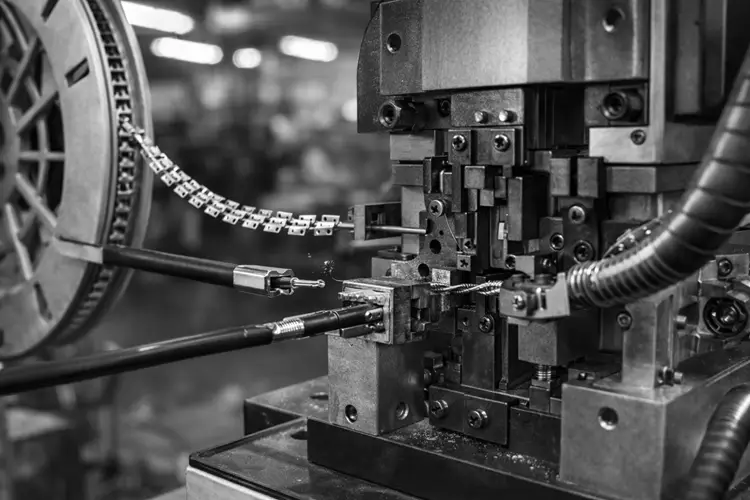
These systems regulate strip length, insertion depth, and compression force. They significantly improve repeatability and reduce human variability.
Fully Automatic Crimping Systems
Designed for high-volume manufacturing, these systems integrate:
- Wire cutting
- Stripping
- Terminal feeding
- Crimping
- In-process monitoring
Sensors measure crimp height and compression force in real time, enabling immediate defect detection.
One of the most critical parameters is crimp height—the final compressed dimension of the conductor barrel.
- Too high indicates under-crimping.
- Too low suggests over-compression and potential strand damage.
Crimp force monitoring systems further enhance quality assurance by analyzing the force-displacement curve during compression. Any deviation from the validated signature flags a defect instantly.
Modern harness manufacturing relies on data-driven validation—not visual inspection alone.
Quality Assurance: Verification, Not Assumption
A robust crimp quality system typically includes:
- Visual inspection for alignment and insulation support
- Pull-out force testing for mechanical strength
- Crimp height measurement with calibrated micrometers
- Cross-sectional micrograph analysis
- Crimp force monitoring records
Pull-out testing is particularly important in vibration-prone environments. It verifies tensile strength and confirms mechanical stability under dynamic stress.
In industries such as automotive, aerospace, and heavy equipment manufacturing, crimp tolerances are tightly controlled. Even minor deviations can result in part rejection.
Inspection is not about identifying errors after production. It is about preventing failures before they reach the field.
Crimping and Long-Term System Stability
Electrical systems rarely fail immediately. Most failures occur after prolonged exposure to:
- Thermal cycling
- Vibration
- Moisture ingress
- Mechanical stress
A properly executed crimp forms a gas-tight interface that resists oxidation, maintains low resistance, and prevents micro-movement between strands—reducing the risk of fretting corrosion.
An imperfect crimp gradually deteriorates. Resistance increases incrementally. Heat builds. Insulation discolors or hardens. Eventually, the circuit fails.
Crimping quality directly correlates with long-term reliability.
In high-vibration environments, the combined integrity of the conductor crimp and insulation crimp provides strain relief and distributes mechanical stress away from the electrical interface.
Crimping is not just about establishing a connection today—it is about preserving performance over the product lifecycle.

Training and Process Discipline
Even with advanced automation, human expertise remains essential.
Operators must understand:
- Specified strip lengths
- Terminal compatibility
- Crimp height tolerances
- Inspection criteria
Engineering teams must define:
- Standard operating procedures
- Calibration intervals
- Tool maintenance schedules
- Acceptance and rejection limits
Consistency is achieved through structured process control. Process control is sustained through training and accountability.
Crimping as a Strategic Control Point
Many manufacturers treat crimping as a routine step. High-performing manufacturers treat it as a strategic advantage.
When crimp integrity is controlled:
- Field failures decrease
- Warranty costs decline
- Customer confidence increases
- Equipment uptime improves
In competitive industries, reliability differentiates brands. And reliability often begins at the crimp.
It may appear to be a small metal barrel compressed around copper strands. But within that compression lies the electrical stability of an entire system.
When evaluating a wire harness, connectors and routing are visible. The true strength, however, is concealed inside each properly engineered crimp.
Crimping correctly is not merely a technical requirement. It is the structural and electrical heart of the harness.
BECO Wire Harness works closely with OEMs and manufacturers to develop harness solutions engineered for electromagnetic compatibility, thermal stability, and high-current performance. Through engineering-led design and controlled manufacturing, BECO Wire Harness delivers wiring systems built for reliability in complex electrical environments.
Learn more at www.becowh.com
