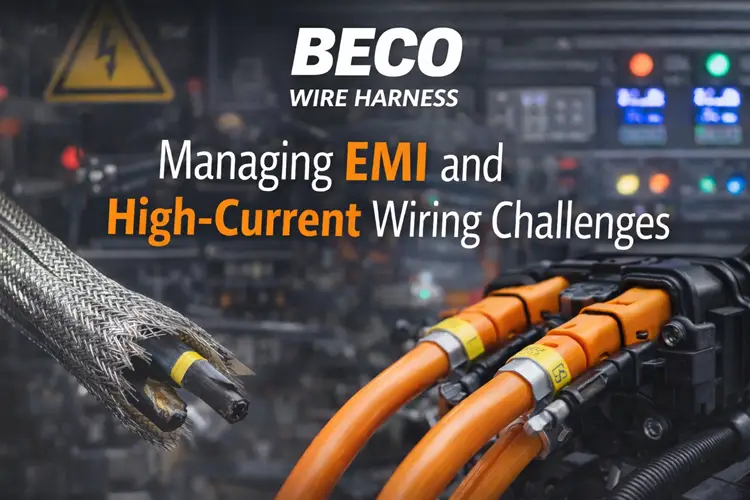
Modern electrical systems are evolving rapidly across industries such as electric mobility, industrial automation, and advanced equipment manufacturing. As systems become more compact and power-dense, engineers face growing challenges related to electromagnetic interference (EMI) and high-current wiring stability. These issues directly impact performance reliability, safety, and system efficiency. BECO Wire Harness recognizes that managing EMI and high-current behavior is critical for ensuring stable electrical operation in demanding applications.
Engineering-led controls are essential to mitigate signal instability, thermal stress, and electromagnetic compatibility risks. With proper design strategies, manufacturers can significantly improve system performance and long-term reliability.
Understanding EMI in High-Power Electrical Systems
Electromagnetic interference occurs when electrical signals disrupt nearby circuits through radiated or conducted emissions. In modern systems, high switching frequencies, dense electronics, and compact layouts increase the likelihood of EMI-related instability. BECO Wire Harness analysis shows that EMI is especially prevalent in high-current environments such as electric vehicles, robotics, battery systems, and power electronics.
Uncontrolled EMI can cause data errors, sensor misreadings, communication disruptions, and unpredictable system behavior. In safety-critical applications, even minor interference can compromise performance integrity.
Challenges of High-Current Wiring
High-current wiring introduces additional complexity beyond EMI concerns. Elevated current flow increases thermal loads, voltage drop risks, and conductor stress. Improper cable sizing or routing can result in localized heating, insulation degradation, and reduced efficiency.
BECO Wire Harness engineers address high-current challenges by carefully balancing conductor cross-section, insulation properties, and routing strategies. Managing heat dissipation and electrical resistance is fundamental to maintaining stable performance under load.
Performance Instability in Compact Architectures
Compact electrical architectures amplify EMI and current-related risks. As components are placed closer together, coupling effects increase and thermal buildup becomes more difficult to manage. Power and signal circuits often share limited routing space, raising the probability of cross-interference.
BECO Wire Harness observes that poorly managed layouts can lead to intermittent faults that are difficult to diagnose. Signal noise, voltage fluctuations, and thermal drift may only appear under specific load conditions, complicating field reliability.
Engineering-Led Controls for EMI Mitigation
Effective EMI control begins with intentional engineering practices. Shielded cables and twisted pair configurations help reduce electromagnetic radiation and susceptibility. Proper grounding and bonding strategies ensure controlled current return paths.
BECO Wire Harness integrates shielding, optimized routing separation, and controlled impedance design to minimize interference risks. Separation of high-power and low-signal circuits is a key strategy for maintaining signal integrity.
Filtering components and connector shielding further enhance electromagnetic compatibility. These engineering controls form the foundation of EMI-resilient harness systems.
Managing Thermal and Current Stability
Thermal management is closely linked to high-current reliability. Elevated temperatures accelerate insulation aging and increase resistance, creating a cycle of performance degradation. BECO Wire Harness selects heat-resistant insulation systems and high-temperature-rated components to ensure durability under sustained load conditions.
Optimized conductor sizing and multi-layer protection strategies help manage heat distribution. Routing away from heat-sensitive components reduces thermal coupling and preserves overall system stability.
Engineering for thermal resilience is essential for high-current wiring success.
Manufacturing Precision and Consistency
Even the best designs require disciplined manufacturing to maintain performance integrity. Variations in crimp quality, shielding termination, or routing accuracy can undermine EMI protection and current stability.
Quality manufacturing reinforces electrical performance stability.
Long-Term Benefits of Engineering-Led Controls
Addressing EMI and high-current challenges at the design stage delivers long-term operational advantages. Stable electrical performance improves system reliability, reduces diagnostic complexity, and enhances safety margins.
Conclusion
As electrical systems grow more powerful and compact, managing EMI and high-current wiring challenges becomes increasingly critical. Performance instability caused by interference and thermal stress can undermine even the most advanced technologies.
BECO Wire Harness works closely with OEMs and manufacturers to develop harness solutions engineered for electromagnetic compatibility, thermal stability, and high-current performance. Through engineering-led design and controlled manufacturing, BECO Wire Harness delivers wiring systems built for reliability in complex electrical environments.
Learn more at www.becowh.com.