
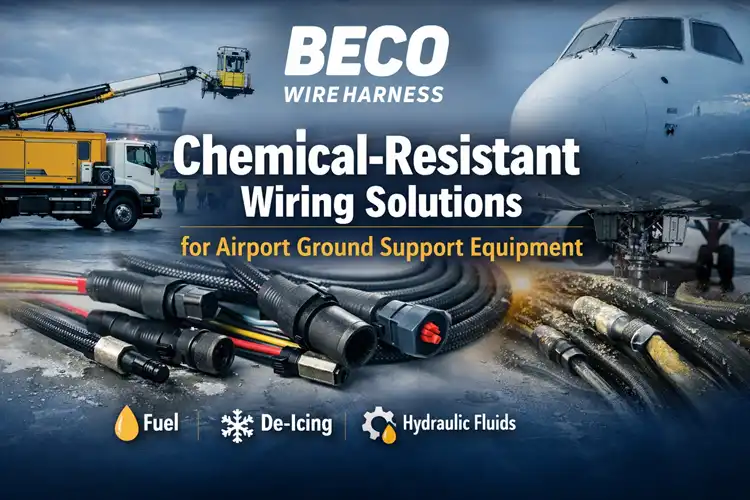
Airport ground operations place extreme demands on electrical systems due to constant exposure to fuels, fluids, and cleaning chemicals. A chemical resistant wire harness for airport ground support equipment is essential to ensure electrical reliability, safety, and long service life in these conditions. Ground vehicles operate daily in harsh chemical environments where insulation degradation, connector failure, and intermittent faults can quickly compromise mission-critical functions.
For OEMs, engineers, and procurement teams, airport ground support equipment wiring must be designed specifically to withstand aviation fuel exposure, de-icing fluids, and hydraulic oils—without sacrificing performance in braking, steering, lighting, or control electronics. This is where purpose-built aviation wire harness solutions become a critical design requirement rather than an optional upgrade.
Chemical Exposure Risks in Airport Ground Support Operations
Airport ground support equipment is routinely exposed to aggressive chemicals throughout daily operations. Fuel trucks, baggage tractors, belt loaders, and de-icing vehicles operate directly around substances that attack standard insulation materials.
Key chemical exposure risks include:
- Aviation fuel exposure that causes insulation softening and swelling
- De-icing fluids with glycol compounds that penetrate jacket materials
- Hydraulic fluids that accelerate cracking and embrittlement
- Cleaning agents used during maintenance and wash-downs.
Without a chemical resistant wire harness for airport ground support equipment, these exposures lead to premature insulation degradation, electrical shorts, and loss of signal integrity. Over time, even minor chemical contact can reduce electrical reliability across ground support equipment electrical systems.
High-Risk Wiring Areas in Airport Ground Support Equipment
Not all wiring is exposed equally. Experience with airport ground support equipment wiring shows that certain areas face repeated and concentrated chemical contact.
High-risk zones include:
- Harness routing near fuel, hydraulic, and lubrication lines
- Low-mounted wiring exposed to spills and pooling fluids
- Connectors near refueling points and de-icing spray zones
- Under-chassis runs exposed during winter operations
A real-world example is a de-icing vehicle where wiring near spray booms is repeatedly exposed to glycol-based fluids. Without sealed connectors and chemical-resistant insulation, these circuits are vulnerable to corrosion and intermittent failures that can disable control electronics during critical operations.
Specialized Insulation Systems for Aviation Wire Harnesses
Effective aviation wire harness solutions rely on insulation systems engineered for harsh chemical environments. Material selection is based on chemical compatibility, temperature stability, and long-term electrical performance.
Common insulation features include:
- Chemically resistant jacketing designed for fuel and fluid exposure
- Protective sleeving and boots in high-risk harness sections
- Over-molded transitions to prevent fluid ingress
- Integration with sealed connectors for environmental protection
These systems help maintain electrical reliability even when ground support equipment operates continuously around fuels, de-icing fluids, and hydraulic systems.
Design and Manufacturing Controls for Chemical Resistance
Chemical resistance must be engineered into the harness from the earliest design stage. At BECO Wire Harness, engineers use application-focused design methods to identify exposure zones and specify appropriate materials for each harness segment.
Design and manufacturing controls include:
- CAD-based harness development to map chemical exposure risks
- Routing strategies that minimize direct contact with fluids
- Controlled manufacturing processes for consistent insulation application
- Validation testing aligned with real operating conditions
Early collaboration through a wire harness consultation allows OEMs to address chemical exposure before production, reducing field failures and redesign costs. BECO’s aviation wire harness expertise supports OEM qualification and long-term platform reliability.
Long-Term Benefits for Airport Operators and OEMs
A properly designed chemical resistant wire harness delivers long-term operational and commercial advantages.
Benefits include:
- Reduced electrical failures in harsh chemical environments
- Improved safety for braking, steering, lighting, and control electronics
- Longer service life and lower maintenance costs
- Greater uptime across airport ground support fleets
OEMs also benefit from fewer warranty claims and improved equipment reputation. Application-specific custom wire harness solutions allow ground support equipment platforms to perform reliably across global airport environments without repeated electrical redesigns.
With deep engineering experience, controlled manufacturing, and close OEM collaboration, BECO Wire Harness designs chemical-resistant wire harnesses built for the realities of airport ground support equipment. If your electrical systems operate around aviation fuels, de-icing fluids, or hydraulic environments, BECO can help you engineer wiring solutions optimized for safety, reliability, and long-term performance.
BECO Wire Harness works closely with OEMs and manufacturers to ensure wire harness solutions are engineered for chemical exposure resistance, safety, and long-term reliability in aviation environments. Through application-focused design and controlled manufacturing, BECO Wire Harness delivers wiring solutions built for the realities of airport operations.
Learn more at www.becowh.com.
