
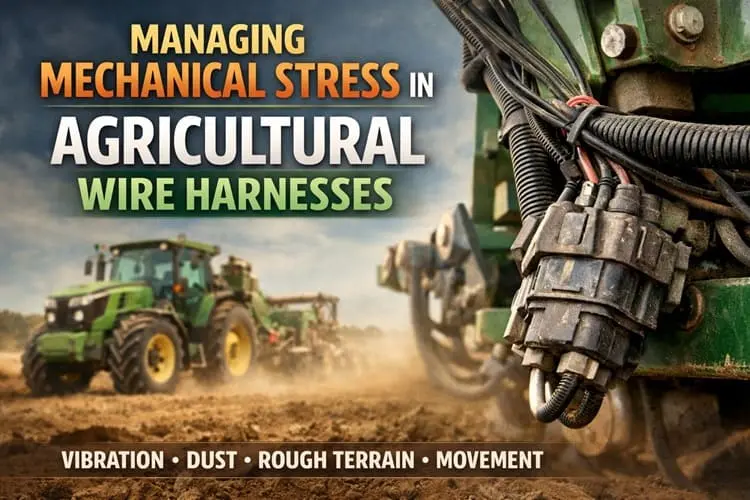
Agricultural machinery operates in some of the most mechanically demanding environments. Continuous vibration, uneven terrain, dust exposure, and extended operating hours place constant physical loads on electrical systems. Among all electrical components, the
agricultural wire harness is one of the most vulnerable to mechanical stress.
Without proper stress management, repeated movement, bending, and pulling gradually weaken conductors, insulation, and connector interfaces. These failures often remain hidden until equipment performance is affected or a complete breakdown occurs.
Mechanical Stress in Agricultural Machinery Wiring
Mechanical stress occurs when physical forces repeatedly act on a wire harness during normal machine operation. In agricultural equipment, these forces are unavoidable due to:
- Engine and drivetrain vibration
- Articulation between moving machine sections
- Continuous field movement over uneven terrain
- Repeated attachment and detachment of implements
Common Causes of Wire Harness Failure in Agricultural Equipment
Uncontrolled mechanical stress leads to predictable and costly failure modes, including:
- Internal conductor breakage caused by repeated flexing
- Insulation cracking and abrasion from tight routing paths
- Loosened terminals and connector fretting due to vibration
- Intermittent electrical faults at high-movement zones
High-Risk Stress Zones in Agricultural Wire Harnesses
Certain areas of an agricultural wire harness are exposed to higher mechanical loads than others. These high-risk zones include:
- Bending points near hinges and articulation joints
- Harness transitions between fixed and moving components
- Connector interfaces exposed to vibration and pull forces
- Tight routing areas where abrasion can occur
Effective wire harness strain management focuses on controlling stress in these areas before damage develops.
Designing Durable and Stress-Resistant Wire Harnesses
Mechanical stress management begins at the design stage. A durable and vibration-resistant wire harness incorporates:
- Optimized routing paths that allow controlled movement
- Proper bend radii to reduce conductor fatigue
- Strain relief at termination and connector points
- Secure mounting to prevent unnecessary vibration
CAD-based harness design helps identify potential stress points early. By accounting for machine movement throughout the equipment lifecycle, mechanical loads can be distributed more evenly across the wiring system.
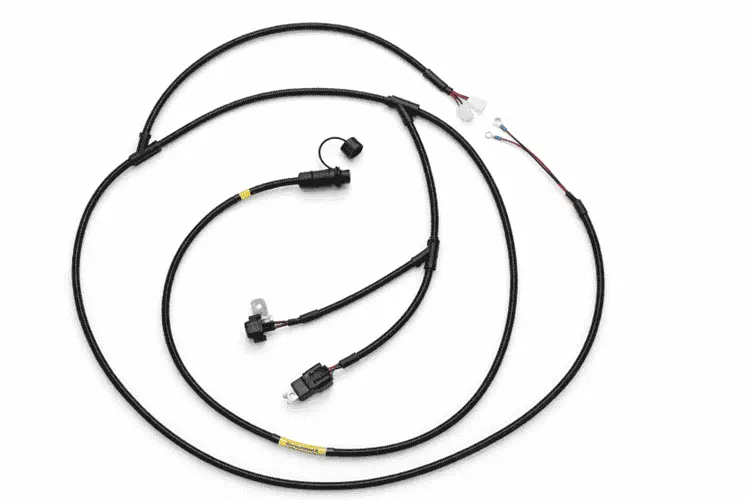
OEM Approach to Long-Term Electrical Reliability
For OEM agricultural equipment manufacturers, wire harness durability directly impacts product reliability, warranty costs, and customer satisfaction. Stress-resistant harness designs help:
- Reduce unplanned downtime during critical operating seasons
- Extend service life of electrical systems
- Improve safety system stability
- Lower maintenance and replacement costs
An engineered OEM agricultural wire harness supports consistent electrical performance in harsh field conditions and contributes to a lower total cost of ownership.
Long-Term Value of Mechanical Stress Management
Proactively managing mechanical stress delivers measurable long-term benefits. Equipment operates more reliably under continuous vibration and movement. Electrical faults are reduced, and maintenance intervals are extended. Over time, this reliability becomes a competitive advantage for both manufacturers and operators.
Conclusion
Mechanical stress is unavoidable in agricultural machinery, but wiring failures are not. BECO WH works closely with OEMs and manufacturers to ensure wire harness solutions are engineered to withstand mechanical stress, vibration, and continuous movement, delivering long-term reliability in demanding agricultural applications.
Learn more about our agricultural wire harness solutions at www.becowh.com
